
Legal Checklist Before Buying a Plot in Bangalore
Buying a plot in Bangalore is often seen as the safest form of real estate investment. After all, land doesn’t depreciate, and there’s no construction risk—right? In reality, plot purchases in Bangalore carry some of the highest legal risks if verification is rushed or incomplete.
The city’s rapid expansion happened across multiple phases, villages, and planning authorities. Revenue land turned residential, layouts emerged before approvals, and documents changed hands informally for years before formal registration caught up. As a result, two plots next to each other can look identical but be legally worlds apart.
Many buyers only discover problems after payment:
- Fake or unauthorised layouts are marketed as “approved”
- Duplicate titles sold to multiple buyers
- Pending court cases are hidden behind partial documents
- B-Khata or Panchayat Khata plots passed off as safe
- Land acquired or marked for future infrastructure
This guide exists to stop that from happening.
What follows is a lawyer-trusted, step-by-step legal checklist designed specifically for Bangalore plots. It helps you verify ownership, identify red flags early, and make decisions based on documents—not assurances. If you follow this checklist methodically, you dramatically reduce the risk of disputes, loan rejection, and resale trouble later.
Why Legal Verification Is Non-Negotiable
Legal due diligence is not a formality in Bangalore; it is risk management.
Land disputes are unusually high
Bangalore has a long history of overlapping claims due to revenue records, inheritance splits, and unregistered transfers. Many disputes surface years after purchase, when construction or resale begins.
High risk of bank loan rejection
Banks scrutinise plots far more strictly than apartments. Missing or unclear documents often lead to outright loan rejection, even if the land looks clean on paper.
Future demolition or sealing risk
Plots in unauthorised layouts, green belts, or road-widening zones can face sealing, denial of utilities, or demolition notices, sometimes years later.
Resale becomes difficult and discounted
A plot with weak documentation may sell initially, but resale buyers and banks dig deeper. Poor legal clarity usually means longer exit timelines and price cuts.
Core Ownership Documents
Before you look at approvals, zoning, or future potential, you must answer one question clearly:
Who legally owns this land, and how did they get it?
Title Deed & Mother Deed Verification
The mother deed traces the property’s ownership history from its earliest available record to the current owner. This is one of the most critical checks.
What to verify:
- Continuous ownership chain (ideally 40–50 years)
- No unexplained transfers or gaps
- Matching survey numbers and boundaries
- Consistency in owner names across documents
Any missing link here increases the risk of future ownership disputes.
Registered Sale Deed
The sale deed proves that the seller legally acquired the property.
Key checks:
- Must be registered at the Sub-Registrar’s Office
- Seller’s name must exactly match the title records
- Property description, survey number, and boundaries must align with other documents
If the sale deed is unregistered or mismatched, ownership itself may be invalid.
Encumbrance Certificate (EC)
The Encumbrance Certificate confirms whether the property is free from financial and legal burdens.
It helps verify:
- No outstanding loans or mortgages
- No court attachments or legal claims
- No sale agreements affecting ownership
Buyers should ideally insist on a 30-year EC to catch older liabilities that may still impact the land.
Ownership Verification Table
| Document | What It Proves | Risk If Missing |
| Mother Deed | Ownership history & continuity | Ownership disputes |
| Title Deed | Legal ownership | Fraud & duplicate claims |
| Sale Deed | Legal transfer to seller | Invalid ownership |
| Encumbrance Certificate (EC) | No loans or litigation | Financial & legal risk |
Why This Checklist Matters
Most plot-related problems don’t arise because buyers ignored all documents—they arise because buyers checked some, but not all, or relied on verbal explanations to fill gaps.
In Bangalore, partial verification is almost as risky as no verification.
This checklist forces clarity. It helps you slow down, ask better questions, and recognise when a deal looks attractive but isn’t legally sound. If a seller hesitates to share any of these documents—or asks you to “adjust later”—consider that your first warning sign.
Before you pay a token amount, before you sign an agreement, and before emotions take over, ensure these ownership checks are complete. Plots reward patience but punish assumptions.
In the next sections, this checklist can be extended further into approvals, zoning, authority checks, and layout compliance—because ownership is only the first layer of safety.
Municipal & Government Approval Checklist
Once ownership is verified, the next layer of safety lies in municipal and government approvals. This is where many plot buyers in Bangalore get misled—because documents exist, but the authority behind them doesn’t match the claim. Every approval must be checked not just for presence, but for validity, relevance, and issuing authority.
Khata Certificate & Khata Extract
Khata is the starting point of municipal recognition.
- Always prefer A-Khata: It indicates that the property is recognised by the municipal authority as compliant with planning and land-use norms. It also supports loans, resale, and future construction.
- Avoid B-Khata: While tax payment is allowed, B-Khata signals partial compliance. It increases loan rejection risk, complicates resale, and raises questions during plan approval.
Ask for both:
- Khata Certificate (proof of registration with the municipality)
- Khata Extract (details of property assessment and tax)
Mismatch between these two is a red flag.
Land Conversion Certificate (DC Conversion / Section 11B)
This is one of the most critical documents for plot buyers.
Large parts of Bangalore were originally agricultural land. Before such land can be used for residential plots, it must be legally converted.
- DC Conversion / Section 11B Certificate confirms lawful conversion from agricultural to residential use.
- Without this, construction approvals may be denied—even if plots are sold and registered.
Never rely on assurances like “conversion is in process” or “conversion is not required here.” If conversion is missing, the risk stays with the buyer.
Approved Layout Plan (Authority-Based)
An approved layout plan tells you who approved the layout—and under which rules. This matters more than buyers realise.
Common approving authorities include:
- BDA – Generally safest and most structured
- BBMP – For layouts within city limits
- BMRDA – Peripheral and suburban layouts
- BIAPPA – Areas around the airport region
- Panchayat approvals – High-risk unless strongly supported by higher-level sanctions
Always verify:
- Approval number and date
- Whether approval covers the entire layout, not just a phase
- Whether civic amenities (roads, parks, drains) are part of the sanction
A layout without proper authority approval may face plan rejection, utility denial, or future regularisation issues.
RERA Registration (If Applicable)
If the plot is part of a promoted project or developed layout, check whether RERA registration applies.
RERA helps buyers by:
- Mandating disclosure of approvals
- Ensuring timelines and accountability
- Protecting against misleading claims
While not all standalone plots fall under RERA, many marketed layouts do. If applicable and missing, treat it as a serious warning sign.
Revenue & Utility Clearances You MUST Check
Municipal approvals alone are not enough. Revenue and utility records often reveal issues that don’t appear elsewhere.
RTC / Pahani
The RTC (Record of Rights, Tenancy, and Crops) or Pahani reflects ownership in revenue records.
Check that:
- Owner name matches title documents
- Land classification aligns with residential use
- No government ownership or acquisition remarks exist
Any mismatch between RTC and title documents requires immediate clarification.
Latest Property Tax Receipts
Always insist on recent property tax payment receipts.
- Confirm taxes are fully paid
- Ensure there are no arrears or penalties
- Match the assessment details with Khata and layout documents
Pending dues can delay registration or transfer future liability to the buyer.
Utility NOCs
Utilities are often taken for granted—until construction begins.
- Electricity (BESCOM): Confirm sanctioned connection or layout-level approval
- Water & Sewage (BWSSB): Especially important within BBMP limits
- Any additional layout-level NOCs required by the approving authority
Absence of utility approvals doesn’t always stop a sale but it can stop construction and habitation later.
“A plot may look perfect today but become problematic when you apply for plan sanction, utilities, or resale. That’s why every approval must be verified independently and patiently.”
Verification of Seller & Authority
Even when a plot looks legally clean on paper, the deal is only as strong as the seller’s legal right to sell. In Bangalore, a large number of disputes arise not because documents were missing, but because the wrong person sold the land. That’s why verifying the seller and the approving authority is a non-negotiable step in your legal checklist.
Seller Identity & Legal Right
Start by confirming who the seller is and in what capacity they are selling.
- Individual seller:
Ask for Aadhaar and PAN Card to confirm identity. Then cross-check the name with the sale deed, Khata, EC, and RTC. Even a small spelling mismatch can create future complications. - Developer or company seller:
Insist on company incorporation documents, authorised signatory proof, and board resolutions permitting the sale. This ensures the person signing the agreement is legally empowered to do so.
This step protects buyers from impersonation risks, unauthorised sales, and future ownership disputes.
Family Tree Certificate (Critical for Inherited Properties)
If the plot is inherited, do not proceed without a Family Tree Certificate.
This document:
- Lists all legal heirs of the original owner
- Confirms that no rightful claimant has been excluded
- Prevents future disputes from siblings, spouses, or children
In Bangalore, many land disputes surface years later when an undisclosed heir challenges the sale. A verified family tree certificate dramatically reduces this risk.
Verified Legal Plots vs Risky Plots – What Buyers Should Clearly Differentiate
The table below helps you separate safe, verified legal plots from risky or unverified ones, using government-backed proof sources instead of verbal assurances
Verified Legal Plots vs Risky / Unverified Plots (With Government Proof)
| Feature | ✅ Verified Legal Plots | ❌ Risky / Unverified Plots | Government Proof / Where to Verify |
| Title Status | Clear title, mother deed verified | Ownership doubts, missing links | Sub-Registrar Office (SRO) |
| Encumbrance Certificate (EC) | Nil encumbrance, no loans or cases | Possible loans or litigation | Kaveri Online Services / SRO |
| Khata Status | A-Khata (legal & recognised) | B-Khata / No Khata / Fake Khata | BBMP / BDA / BMRDA / Panchayat |
| Land Conversion | DC conversion approved for residential use | Still agricultural / revenue land | Deputy Commissioner Office |
| Layout Approval | Approved by BDA / BMRDA / BBMP | Revenue or unauthorised layout | BDA / BMRDA / BBMP / LPA |
| RERA Registration (if applicable) | Registered under Karnataka RERA | Not registered | Karnataka RERA Portal |
| Property Tax Status | Taxes paid and up to date | Pending or unpaid dues | BBMP / Local Authority |
| RTC / Mutation Records | Deputy Commissioner’s Office | Old entries or disputes | Karnataka Revenue Department |
| Bank Loan Approval | Easily approved by banks | Mostly rejected | Bank legal verification reports |
| Resale Value | High demand, easy resale | Hard to sell, low demand | Market acceptance |
| Legal Peace of Mind | Safe and hassle-free | Risk of cases or demolition | Verified legal documentation |
| Family Safety & Future Security | Stable, secure investment | Financial and legal uncertainty | Government-backed proof |
Pro Legal Tips for Plot Buyers in 2026
By 2026, buying a plot in Bangalore is no longer about intuition or referrals—it’s about verification-first decision-making. As land prices rise and scrutiny tightens, smart buyers now treat legal checks as their first site visit.
Online Verification First
Before you even step onto the land, start online. Digital records have matured, and ignoring them is a costly mistake.
Use Kaveri Online Services to verify sale deeds, encumbrance certificates, and registration history. Cross-check project claims on Karnataka RERA portals where applicable. Then, visit the official websites of approving authorities to confirm layout approvals and jurisdiction. These online checks quickly separate serious opportunities from risky listings—often within minutes.
Always Do a Physical Survey
Once documents look clean, move offline. Never rely only on maps or brochures.
Physically visit the plot and:
- Cross-check the site number against the layout plan
- Verify boundary markings and cornerstones
- Compare the actual plot position with the approved layout map
Many disputes arise because buyers purchased the “right plot on paper” but the wrong land on site. A physical survey ensures what you see is exactly what you’re buying.
Take an Independent Legal Opinion
No matter how confident you feel, always involve an independent property lawyer. This is not optional—it’s protection.
A qualified lawyer will:
- Validate ownership and title continuity
- Prepare a detailed title report
- Flag hidden risks or documentation gaps
- Provide a due-diligence clearance before payment
This step often uncovers issues buyers miss—especially in inherited or multi-owner properties.
More Future Documents & Safety
As regulations evolve, buyers must look beyond traditional documents.
Additional Legal & Safety Checks
- The Possession Certificate confirms a lawful handover
- General Power of Attorney (GPA), if used, must be valid, registered, and limited
- Sanctioned development plans reveal what can actually be built
- Litigation search helps detect pending court cases beyond EC records
These checks add a future-proof layer of safety, especially for long-term investors.
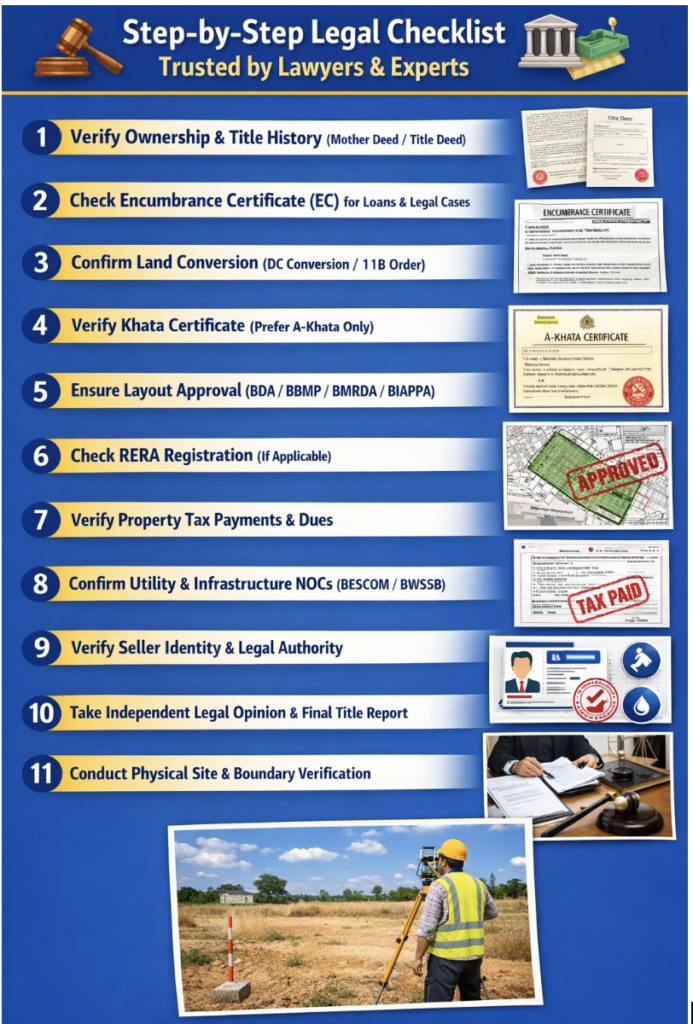
Final Legal Verification Checklist
Before you proceed, pause and review this final checklist. Every item should be a clear “yes”:
- Mother / Title Deed verified
- Sale Deed registered
- Encumbrance Certificate clean
- A-Khata confirmed
- DC Conversion completed
- Layout approval verified
- RERA status checked
- Property taxes fully paid
- Utility NOCs cleared
- Seller identity verified
- Independent legal opinion obtained
- Physical survey completed
Conclusion
Buying a plot is both an emotional milestone and a long-term financial commitment. In Bangalore’s complex real estate landscape, emotions should never override verification. Legal safety equals lifetime security; it protects not just your money, but your peace of mind, resale value, and plans.
The smartest buyers don’t chase deals; they choose legally verified, authority-approved plots that stand strong over time. When documents are clean, approvals are clear, and risks are known, your investment truly becomes an asset, not a liability.
FAQ
How do I verify the title deed and ownership legally?
Verify registered documents at the Sub-Registrar Office and cross-check ownership continuity through the mother deed and encumbrance certificate. A property lawyer should validate this.
Is A-Khata compulsory for buying plots?
While not legally compulsory for registration, A-Khata is strongly preferred. It reduces loan rejection risk, supports construction approvals, and improves resale ease.
What is an Encumbrance Certificate, and why is a 30-year EC important?
An EC shows whether the property has loans, mortgages, or legal cases. A 30-year EC helps uncover older liabilities that may still affect ownership.
How do I check if a layout is legally approved?
Verify the layout approval authority (BDA, BBMP, BMRDA, BIAPPA, etc.) and cross-check approval numbers with official authority records—not brochures.
Is DC Conversion mandatory for residential plots?
Yes, if the land was originally agricultural. Without DC Conversion, residential construction approvals can be denied in the future.
Can I get a bank loan without clear legal documents?
Most banks will reject loans if the title, Khata, conversion, or approvals are unclear. Clear documentation is essential for financing.
What legal checks are required for NRI buyers in Bangalore?
NRIs must verify title, approvals, FEMA compliance, power of attorney validity, and ensure repatriation clarity through legal counsel.
What risks exist if I skip legal verification?
Skipping checks can lead to ownership disputes, loan rejection, demolition risk, resale difficulty, and years of legal battles.
How does a legal expert help in plot verification?
A legal expert conducts title due diligence, identifies hidden risks, validates documents, and ensures you proceed only when the property is legally safe.
One thought on “Legal Checklist Before Buying a Plot in Bangalore”