
Karnataka Taps Japan for Bengaluru Smart City Development: What It Means for the City’s Future

Bengaluru has always been known as India’s Silicon Valley — a city that drives innovation, attracts global companies, and offers immense opportunities. However, rapid growth has also brought significant challenges. Traffic congestion, water shortages, unplanned expansion, and infrastructure strain have become everyday realities for residents.
To address these growing concerns, Karnataka has taken an important step. The state government is now collaborating with Japan to develop smart city solutions for Bengaluru. This partnership aims to combine Japan’s advanced urban-planning expertise with Bengaluru’s technology ecosystem to create a more sustainable, future-ready city.
This move is not just about improving infrastructure. It also signals Bengaluru’s next phase of development, one that focuses on smarter planning, better connectivity, and improved quality of life.
Karnataka–Japan Smart City Partnership: What Happened?
The Karnataka government has initiated discussions with Japan to develop smart city solutions for Bengaluru. The collaboration involves working with Japanese government agencies and private companies that specialise in urban infrastructure, smart mobility, and sustainable development. Japan’s Ministry of Land, Infrastructure, Transport and Tourism (MLIT) is expected to play a key role in guiding the planning and implementation of smart city initiatives. Japanese companies, known for their precision and efficiency in urban development, may also participate in designing and executing various smart infrastructure solutions.
The partnership is expected to follow a structured approach. First, authorities will identify Bengaluru’s most pressing urban challenges. These may include traffic congestion, water management, waste disposal, and infrastructure planning. Once the challenges are identified, Japanese experts will propose technology-driven solutions based on global best practices. The final stage will involve implementation, where local authorities and Japanese companies will collaborate to deploy smart city technologies. This step-by-step process ensures that the solutions are practical, scalable, and suitable for Bengaluru’s urban landscape.
This initiative reflects Karnataka’s intent to bring global expertise into local infrastructure planning and build a city that can support future growth.
Why Karnataka Is Partnering With Japan
Japan is widely recognised for its advanced infrastructure and smart city planning. Cities like Tokyo, Osaka, and Yokohama have successfully implemented smart urban solutions that improve efficiency and sustainability.
Japan’s urban planning model focuses on long-term sustainability, efficient transport networks, and technology-driven governance. These are areas where Bengaluru currently faces challenges.
For example, Japan has developed:
- Highly efficient public transport systems
- Advanced traffic management technologies
- Smart energy solutions
- Disaster-resilient infrastructure
- Sustainable waste management systems
These solutions have helped Japanese cities maintain a high quality of life despite large populations.
Karnataka sees this partnership as an opportunity to learn from Japan’s experience and implement similar solutions in Bengaluru. The collaboration also strengthens international ties and opens the door for future technology partnerships.
Another key advantage is that Japan’s approach focuses on long-term planning rather than short-term fixes. This aligns with Bengaluru’s need for sustainable growth and infrastructure development.
Key Areas Where Japan Will Help Bengaluru
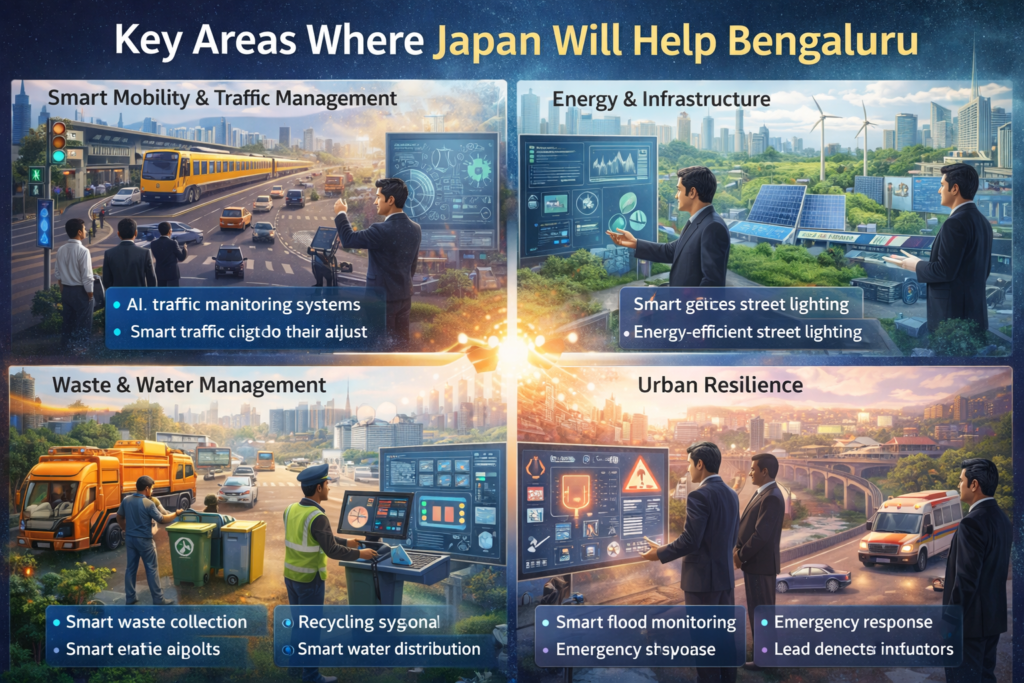
The Karnataka–Japan collaboration is expected to focus on several critical areas that impact everyday life in Bengaluru.
Smart Mobility & Traffic Management
Traffic congestion is one of Bengaluru’s biggest challenges. Daily commutes often take hours, affecting productivity and quality of life.
Smart mobility solutions could help address these issues through:
- AI-based traffic monitoring systems
- Smart traffic signals that adjust based on congestion
- Integrated public transport systems
- Smart parking solutions
- Better last-mile connectivity
Japan’s experience in managing high-density urban traffic can bring effective solutions. For example, real-time traffic management systems can reduce congestion and improve commute times.
Smart mobility also includes improving metro connectivity, integrating buses, and enhancing pedestrian infrastructure. These improvements can create a more efficient and commuter-friendly city.
Energy Efficiency & Sustainable Infrastructure
As Bengaluru grows, energy demand continues to increase. Sustainable energy management is essential to support long-term growth.
Japan’s expertise in energy-efficient infrastructure could help Bengaluru adopt:
- Smart grids for better energy distribution
- Renewable energy integration
- Energy-efficient street lighting
- Smart buildings with reduced energy consumption
These initiatives not only reduce energy costs but also contribute to environmental sustainability.
Energy-efficient infrastructure is particularly important for residential and commercial developments. Smart buildings with energy-efficient systems can improve long-term livability and reduce operational costs.
Waste Management & Water Solutions
Waste management and water scarcity are major concerns in Bengaluru. Rapid urbanisation has increased pressure on existing systems.
Japan has developed advanced waste management systems that focus on:
- Smart waste collection
- Recycling systems
- Waste-to-energy solutions
- Efficient disposal methods
Water management solutions may include:
- Smart water distribution systems
- Rainwater harvesting integration
- Wastewater recycling
- Leak detection technology
These systems can significantly improve resource management and reduce environmental impact.
Better waste and water management also improves living conditions and enhances overall urban sustainability.
Disaster Management & Urban Resilience
Urban resilience is becoming increasingly important as cities grow. Bengaluru has experienced flooding in recent years due to unplanned development and drainage issues.
Japan is known for its disaster preparedness and resilience planning. Bengaluru may benefit from:
- Smart flood monitoring systems
- Early warning technologies
- Improved drainage infrastructure
- Emergency response systems
These solutions can help cities respond quickly to emergencies and minimise disruptions.
Urban resilience planning also ensures that infrastructure remains functional during unexpected events, improving long-term stability.
How This Will Be Implemented
The Karnataka government plans to adopt a collaborative and technology-driven approach to implement smart city solutions.
The implementation may involve:
- Collaboration with Japanese companies
- Startup-led innovation
- Technology pilots in selected areas
- Public-private partnerships
Startups in Bengaluru may also get opportunities to participate in smart city initiatives. This encourages innovation and local participation.
The Greater Bengaluru Authority is expected to coordinate with stakeholders and oversee project execution. This centralised approach ensures smooth implementation and faster decision-making. Pilot projects may be launched first before a large-scale rollout. This helps evaluate effectiveness and refine solutions.
Why This Is Important for Bengaluru
Bengaluru is growing rapidly, and infrastructure needs to keep pace with this growth. Smart city solutions can address current challenges and support future expansion.
This collaboration can help:
- Improve urban planning
- Reduce congestion
- Enhance sustainability
- Improve quality of life
- Attract global investments
Smart infrastructure also improves business ecosystems. Companies prefer cities with efficient infrastructure, better connectivity, and high livability.
This makes Bengaluru more attractive for both businesses and residents.
Impact on Real Estate Market in Bengaluru
Smart city development often leads to strong real estate growth. Infrastructure improvements typically increase demand for residential and commercial properties.
Key impacts may include:
- Increased property demand
- Better connectivity in emerging corridors
- Improved livability
- Higher long-term appreciation
Investors often look for cities with strong infrastructure development. Smart city initiatives signal long-term growth potential.
Areas benefiting from infrastructure upgrades often see rising property values. This makes smart city development important for both investors and homebuyers.
Karnataka’s Larger Global Investment Strategy
This partnership with Japan is part of Karnataka’s broader strategy to attract global investment and improve infrastructure.
The state is focusing on:
- Technology partnerships
- Infrastructure development
- Smart city initiatives
- Innovation ecosystems
Japan’s involvement strengthens Karnataka’s global positioning. It also encourages other international collaborations.
This move reflects Karnataka’s ambition to develop world-class cities and support economic growth.
Karnataka Japan Smart City Partnership | What This Means for Residents
For Bengaluru residents, this partnership could bring meaningful improvements in daily life.
Possible benefits include:
- Reduced commute times
- Better infrastructure
- Cleaner environment
- Improved water management
- Enhanced public services
Smart city initiatives focus on improving everyday experiences. This makes cities more livable and sustainable.
Bengaluru’s Smart City Future
Bengaluru is already known for innovation and technology. Smart city development is the next step in its growth journey.
With Japan’s expertise, Bengaluru could transform into a more efficient and sustainable city. This collaboration may also set an example for other Indian cities.
Smart infrastructure, better planning, and technology-driven governance can shape Bengaluru’s future.
Final Thoughts on Karnataka Japan Smart City Partnership
Karnataka’s collaboration with Japan for Bengaluru smart city development marks an important milestone. By combining global expertise with local innovation, Bengaluru can address infrastructure challenges and support long-term growth.
This partnership is not just about technology; it is about building a smarter, more sustainable city for future generations. For residents, businesses, and investors, this signals a promising future for Bengaluru.
As the city continues to evolve, smart city initiatives like this will play a crucial role in shaping Bengaluru’s next phase of growth.
FAQs on Karnataka Japan Smart City Partnership
What is the Karnataka–Japan smart city initiative for Bengaluru?
The Karnataka–Japan smart city initiative aims to develop smarter infrastructure in Bengaluru. This includes improving traffic management, energy efficiency, waste management, water systems, and urban planning using Japanese expertise and technology.
How will the Japan partnership improve Bengaluru’s infrastructure?
Japan’s involvement may bring AI-based traffic systems, smart energy grids, better waste management, improved water distribution, and smart mobility solutions. These improvements aim to reduce congestion, enhance sustainability, and improve overall city planning.
Which areas of Bengaluru will benefit from the smart city development?
The smart city development may initially focus on high-growth corridors and infrastructure-strained areas. Over time, the solutions are expected to expand across Bengaluru, improving connectivity, mobility, and urban infrastructure citywide.
How will this partnership impact Bengaluru real estate?
Smart city infrastructure typically increases property demand and long-term appreciation. Improved connectivity, better infrastructure, and sustainable development often make Bengaluru more attractive for homebuyers and investors.
What smart city solutions will Japan introduce in Bengaluru?
Japan may introduce smart traffic management, energy-efficient systems, disaster-resilient infrastructure, waste management solutions, and smart urban planning models to improve Bengaluru’s infrastructure.
When will the Karnataka-Japan smart city project start?
The project is expected to begin with identifying key urban challenges, followed by planning and pilot implementations. The development will likely be phased, with gradual rollout across Bengaluru.
Why is Japan considered a leader in smart city development?
Japan is known for advanced urban planning, efficient public transport, disaster resilience, and sustainable infrastructure. Cities like Tokyo and Osaka serve as global examples of smart and well-planned urban development.
Will this smart city initiative improve Bengaluru traffic problems?
Yes, one of the key focus areas is smart mobility and traffic management. AI-based traffic systems, better public transport integration, and improved road planning could help reduce congestion and improve commute times.
What does this partnership mean for Bengaluru’s future growth?
The Karnataka-Japan partnership signals long-term infrastructure development and global collaboration. This could improve livability, attract investments, boost real estate growth, and position Bengaluru as a future-ready smart city.