
End-Use Villa vs Plot Construction in Bangalore: Which Development Model Is Smarter Today?
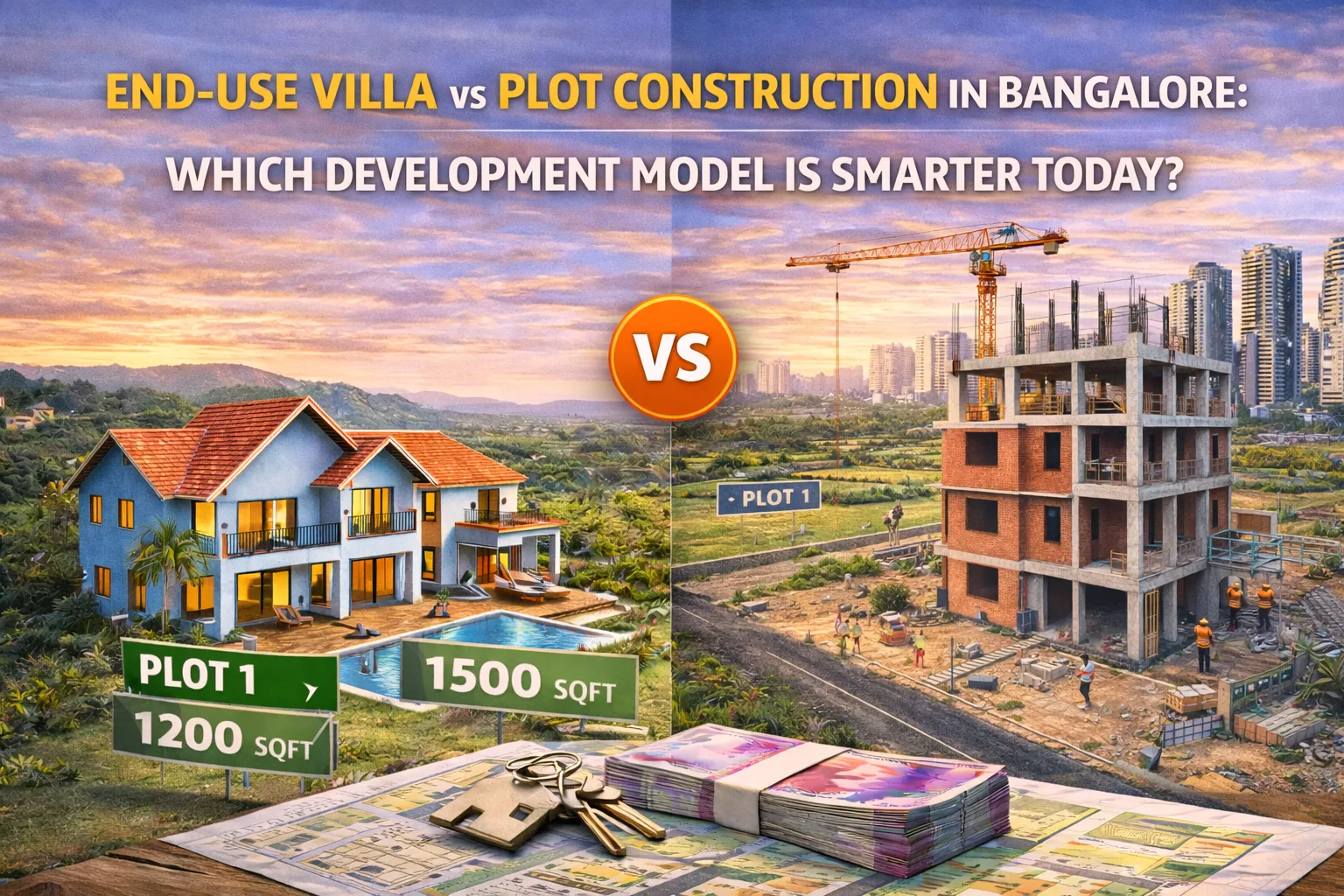
For real estate developers in Bangalore, one of the most important strategic decisions today is choosing between end-use villa development and plotted layouts. Both models have historically performed well in the city, but the post-COVID, post-RERA market has fundamentally changed buyer behaviour, cost structures, and project risk dynamics. What once worked as a standard template may not work anymore. Developers now have to consider buyer psychology, approval complexity, capital lock-in, and infrastructure growth patterns before deciding whether a land parcel should be developed as villas or plots. Let’s deep dive into End-Use Villas vs Plot Construction in Bangalore in detail.
Shifting Buyer Behaviour Post-COVID & Post-RERA
The pandemic accelerated demand for independent living formats, pushing many buyers toward villas and villa communities. Families began prioritising privacy, open space, and low-density environments over compact apartment living.
At the same time, plot investments continued to attract a large segment of buyers, especially investors who prefer land appreciation and flexible construction timelines.
Another important factor influencing the market is budget sensitivity and loan dependency. Villa buyers typically rely on housing loans, making them more cautious and slower in decision-making. Plot buyers, on the other hand, often invest with long-term appreciation in mind, allowing for faster transactions in price-sensitive markets.
Why Developers Are Re-evaluating Traditional Villa & Plot Models
Developers across Bangalore are also reassessing their product strategy due to several operational realities.
Approval processes have become more structured after RERA, increasing compliance timelines and documentation requirements. At the same time, holding costs have risen sharply, especially in high-value corridors like Sarjapur Road, Whitefield outskirts, and North Bangalore.
Land pricing escalation has further complicated the decision. In many emerging corridors, land costs have doubled in the last five to seven years, forcing developers to rethink which model can deliver faster absorption and sustainable margins.
Understanding the Two Models: End-Use Villas vs Plot Construction
Before evaluating which model works better, it is important to understand how these two development formats differ in structure and execution.
What Defines an End-Use Villa Project?
End-use villa projects are designed primarily for families who plan to live in the community. Buyers often include NRIs, professionals working in tech corridors, and high-income households looking for privacy and lifestyle upgrades.
Villa projects usually involve:
- Larger land parcels with gated community planning
- Construction of individual villas with shared amenities
- Longer development and construction cycles
- Higher ticket sizes per unit
Because the developer is responsible for construction, amenities, and delivery, execution complexity is significantly higher compared to plotted layouts.
What Defines a Plot Development Model?
Plotted developments, on the other hand, focus on selling land parcels with basic infrastructure such as roads, drainage, and utilities. Buyers in these projects include both investors and end users, but the majority often purchase with a long-term appreciation mindset.
Plot developments offer several advantages to developers:
- Lower construction responsibility
- Phased development flexibility
- Faster sales cycles in the right micro-markets
This model also allows developers to exit faster from the project by selling plots in phases, reducing long-term capital lock-in.
Bangalore Market Context: Where Each Model Works Best
The success of either model in Bangalore depends heavily on micro-market dynamics.
Villa-Led Micro-Markets
Certain parts of Bangalore have shown strong demand for villa communities, particularly in areas with strong employment hubs and lifestyle infrastructure.
Examples include:
- North Bangalore – Devanahalli and Yelahanka regions are driven by airport connectivity and future infrastructure growth.
- East Bangalore – Sarjapur Road and Varthur outskirts, supported by proximity to IT corridors.
These areas attract end-use buyers willing to pay premium prices for gated villa communities.
Plot-Driven Micro-Markets
Peripheral corridors tend to favour plotted development due to lower entry costs and higher investor participation.
Examples include:
- Anekal belt
- Hoskote corridor
- Kanakapura Road outskirts
These markets attract buyers looking for long-term land appreciation rather than immediate residential construction.
Cost Structure Comparison for Developers | End-Use Villas vs Plot Construction
Land Acquisition & Entry Cost
Villa projects typically require higher capital commitment per unit, since developers must account for construction, infrastructure, and amenities.
Plotted layouts, however, allow developers to enter projects with lower upfront investment per saleable unit, making them less capital-intensive.
Construction, Infrastructure & Compliance Costs
Villa development involves significant construction expenditure, including:
- Building structures
- Clubhouses and amenities
- Utilities and internal roads
- Final occupancy certificate compliance
Plot developments require infrastructure creation only, such as roads, drainage systems, and electrical layouts.
This difference significantly reduces execution complexity for plotted projects.
Holding Cost & Cash-Flow Implications
Villa projects often involve longer development cycles, increasing holding costs and financing risk.
Plotted developments can generate faster cash flow through phased sales, allowing developers to reinvest capital earlier.
Approval & Regulatory Complexity in Bangalore
Approval Path for Villa Projects
Villa developments require multiple approvals depending on the jurisdiction, including:
- BBMP or BDA planning approvals
- BIAAPA approvals in North Bangalore zones
- Occupancy certificates after construction completion
These processes can extend project timelines and increase regulatory oversight.
Approval Path for Plot Developments
Plot projects require layout approval, land conversion compliance, and infrastructure planning clearances.
However, developers sometimes underestimate risks around Khata documentation, conversion approvals, or incomplete layout compliance, which can later affect buyer confidence and resale potential.
Buyer Demand & Sales Velocity Comparison
Villa buyers are typically end-users driven by lifestyle needs, while plot buyers are more ROI-focused investors.
Villa purchases are often emotional decisions linked to family living standards, while plot purchases are typically driven by land appreciation potential.
Impact on Sales Cycles & Negotiation Power
Villa transactions involve higher ticket sizes, which can slow down the sales cycle and increase negotiation intensity. Plot sales tend to close faster, but buyers are more price-sensitive, especially in emerging corridors.
Margin, Risk & Scalability Analysis | End-Use Villas vs Plot Construction
Margin Stability vs Volume Play
Villa developments generate higher per-unit revenue but tighter margins due to construction costs.
Plotted projects often operate on lower margins per unit but benefit from higher transaction volumes and faster churn.
Execution & Market Risk Exposure
Villa projects carry higher risks related to:
- Construction delays
- Labour availability
- Material price fluctuations
Plot developments face comparatively lower execution risk but may encounter regulatory or documentation challenges if approvals are not handled carefully.
Common Developer Mistakes in Choosing the Wrong Model
Developers often face challenges when the chosen product format does not align with the micro-market demand.
Some common mistakes include:
- Building villa communities in markets that primarily demand plotted investments
- Underestimating approval timelines and holding costs
- Over-designing projects beyond the price sensitivity of the local buyer base
Such misalignment can significantly slow down project absorption.
Strategic Framework: How Developers Should Choose Between Villas & Plots
Choosing the right model requires evaluating multiple factors.
Land Location & Zoning Fit
The location and zoning regulations of a land parcel often determine whether villa development or plotted layouts are more viable.
Capital Availability & Risk Appetite
Developers with higher capital reserves and longer investment horizons may pursue villas, while those seeking faster project churn may prefer plotted layouts.
Brand Positioning & Portfolio Strategy
Developers also need to consider their brand identity and long-term project portfolio when deciding the development format.
Real-World Use Cases from Bangalore
When Villa Projects Outperformed Expectations – Villa developments have performed strongly in end-use driven markets, especially in areas with strong IT employment hubs and premium residential demand.
When Plot Developments Delivered Faster ROI – Plotted layouts have shown strong returns in peripheral growth corridors, where land appreciation drives investor interest.
Conclusion on End-Use Villas vs Plot Construction
The decision between villas and plotted developments should always be market-led and approval-aware, rather than based on industry trends alone. Understanding micro-market demand, capital structure, and regulatory complexity is essential before launching a project.
How Houzbay Helps Developers Choose the Right Model
At Houzbay, we work closely with developers to evaluate land parcels and identify the most suitable development strategy.
Our process includes:
- Market demand mapping
- Approval and compliance assessment
- Product positioning and pricing strategy
- Go-to-market planning and sales execution
By aligning land, product, and buyer demand, developers can achieve faster absorption, stronger margins, and lower project risk.
FAQs on End-Use Villas vs Plot Construction
Which Bangalore areas are better suited for villa projects versus plotted developments?
Villa projects work well in end-use driven areas like Sarjapur Road, Devanahalli, and Yelahanka where buyers look for lifestyle communities. Plotted developments perform better in peripheral growth corridors such as Anekal, Hoskote, and Kanakapura Road where investors focus on land appreciation.
What approval risks should developers consider for villas vs plots in Bangalore?
Villa projects require multiple approvals including building plans, utilities, and occupancy certificates, which can extend timelines if not managed carefully. Plot developments mainly require layout approvals and land conversion compliance, but documentation issues like Khata or zoning can create problems later.
Do Bangalore buyers prefer villas or plots in 2026?
Both segments have strong demand, but the buyer profile differs. End-use families and NRIs prefer villas for lifestyle living, while investors often choose plots for long-term appreciation and flexible construction.
How do sales velocity and holding costs differ between villas and plotted projects?
Villa projects usually have slower sales cycles because of higher ticket sizes and construction timelines. Plotted developments typically see faster transactions, helping developers reduce holding costs and generate quicker cash flow.
When does plot development make more sense than villas for developers?
Plot development works better in price-sensitive or emerging micro-markets where buyers prefer lower entry costs and long-term investment potential. It is also suitable when developers want quicker project churn and lower construction exposure.
How should developers decide between villa and plot projects based on land location?
Developers should study local buyer demand, connectivity, nearby employment hubs, and infrastructure growth before deciding the product format. Markets with strong end-use demand favour villas, while investment-driven corridors usually perform better with plotted layouts.
Interesting breakdown—I’ve noticed that villa communities are increasingly favored by families seeking privacy, while plots attract more investor-driven purchases. Balancing these trends must be a real challenge for developers in Bangalore.