
How Job Creation Affects Property Prices: Understanding the Connection Between Employment and Real Estate
When people think about property prices, they often focus on factors such as infrastructure, connectivity, amenities, or upcoming developments. While these certainly play an important role, one of the strongest drivers of real estate appreciation is often overlooked: job creation.
The relationship between employment growth and the housing market is stronger than many people realise. Every new company, industrial park, IT hub, manufacturing unit, or business district creates employment opportunities. As more people move to these areas for work, the demand for housing naturally increases. Over time, this demand influences property prices, rental values, and overall real estate appreciation.
Understanding how job creation affects property prices can help homebuyers, investors, and developers make better investment decisions. Instead of focusing only on today’s property value, smart investors look at where jobs are being created because that often signals where property prices are likely to rise in the future.
In this article, we’ll explore how employment growth influences the real estate market, why job hubs become investment hotspots, and what buyers should look for before investing.
Why Job Creation Matters in Real Estate
Real estate markets are largely driven by demand. One of the biggest reasons demand increases in a particular location is that people move there for employment.
Whenever companies establish offices, factories, research centres, logistics parks, or business campuses, they generate thousands of direct and indirect jobs. Employees working in these organisations need homes, transportation, schools, healthcare, shopping centres, and recreational spaces.
This creates an entire ecosystem that supports long-term property appreciation.
Simply put:
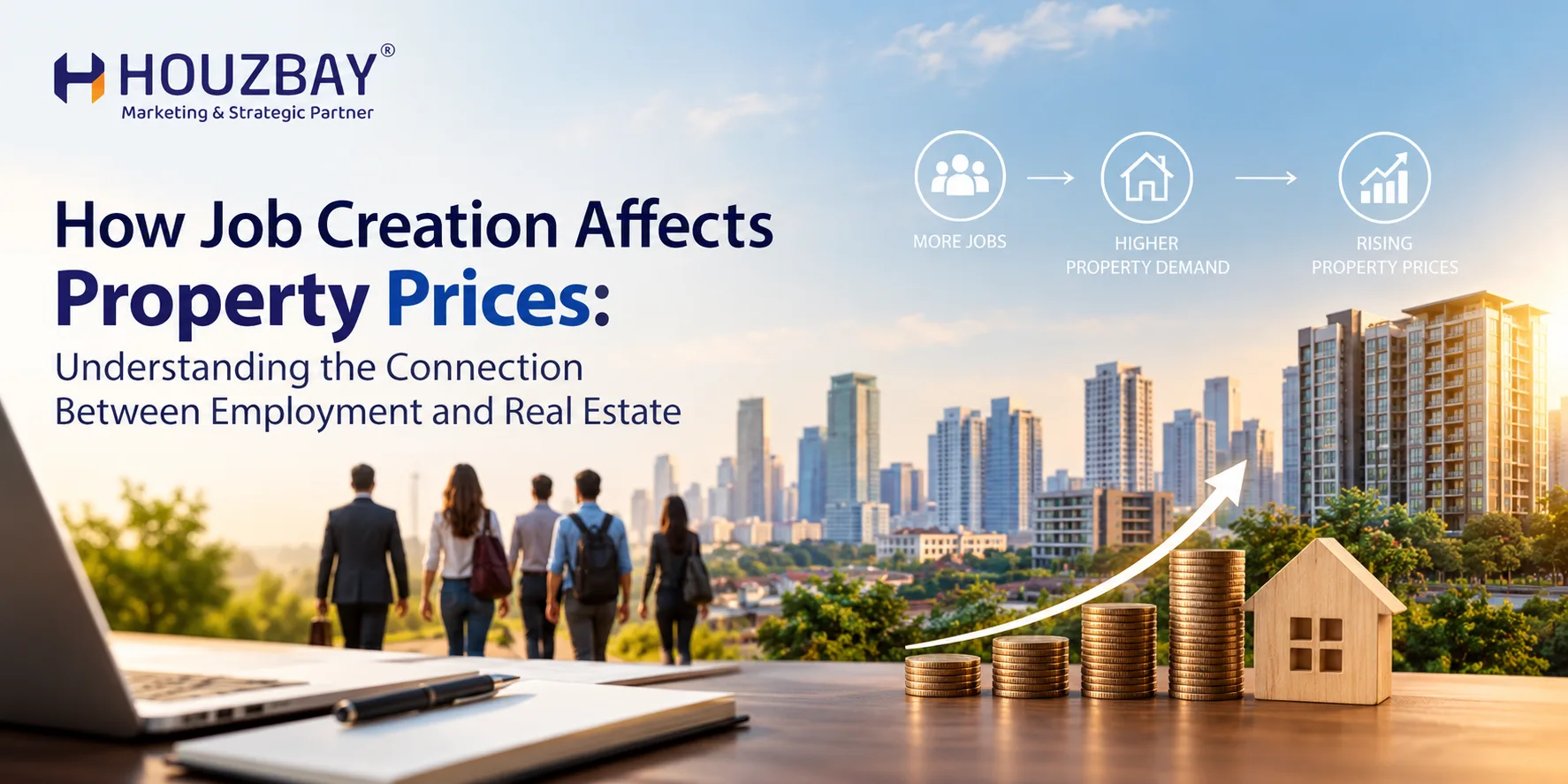
More Jobs → More People → Higher Housing Demand → Rising Property Prices
This cycle has been observed in major cities across India and around the world.
Understanding the Property Demand Cycle
The impact of job creation doesn’t happen overnight. Property markets usually follow a gradual growth cycle.
| Stage | Market Impact |
| Companies announce investments | Investor interest begins |
| Infrastructure development starts | Developers enter the market |
| Businesses begin hiring | Population increases |
| Rental demand rises | Property demand grows |
| Residential projects expand | Property prices appreciate |
| Commercial activity increases | Long-term market growth |
Investors who enter early often benefit from greater appreciation over time.
How Employment Growth Creates Housing Demand
Every job creates the need for housing. Whether someone is relocating from another city or looking to live closer to work, housing becomes a necessity. Different professionals have different housing preferences.
For example:
- Young professionals often prefer apartments close to business districts.
- Families usually choose larger apartments or villas in well-connected neighbourhoods.
- Senior executives may look for luxury gated communities.
- Industrial workers often choose affordable housing nearby.
As employment opportunities grow, demand increases across multiple housing segments rather than just one category.
This broad demand helps stabilise property markets and supports long-term appreciation.
Why Companies Influence Property Prices
Whenever a major employer enters a region, confidence in that location increases. Businesses don’t invest billions of rupees without long-term plans. Their presence often signals future economic growth.
As companies expand, several positive developments usually follow:
- Better roads
- Improved public transport
- Retail development
- Hospitals
- Schools
- Restaurants
- Entertainment zones
- Banking services
These improvements make the location more attractive for residents, further increasing demand for property.
The Ripple Effect of Job Creation
Job creation doesn’t only benefit employees. It also creates opportunities for:
- Restaurants
- Grocery stores
- Cafes
- Schools
- Hospitals
- Banks
- Logistics companies
- Service providers
- Retail businesses
- Construction companies
As commercial activity expands, land becomes more valuable. This is why property prices in employment hubs often appreciate steadily over several years.
Did You Know
Every large corporate office creates demand not only for housing but also for retail, education, healthcare, hospitality, and transportation, multiplying the impact on local property values.
Why Rental Demand Increases
Employment growth not only increases property sales. It also boosts rental demand. Many professionals relocate before deciding to buy a home. Initially, they rent apartments near their workplace. As more employees move into an area:
- Rental occupancy increases.
- Vacancy rates decrease.
- Rental yields improve.
- Investors receive better monthly income.
Strong rental demand often attracts additional investors, creating even more activity in the real estate market.
Infrastructure and Employment Work Together
Job creation alone isn’t enough. Infrastructure plays an equally important role. People prefer locations where commuting is convenient. That’s why governments usually invest in:
- Metro connectivity
- Highways
- Flyovers
- Ring roads
- Railway stations
- Airports
- Bus terminals
Better connectivity makes employment hubs more accessible. As accessibility improves, more people choose to live nearby, increasing property demand.
Industries That Drive Property Appreciation
Not all industries have the same impact on real estate. Some sectors generate stronger and more consistent housing demand. These include:
IT and Technology
Technology parks attract thousands of skilled professionals, creating sustained demand for residential housing.
Manufacturing
Large manufacturing facilities employ workers across multiple income groups, increasing demand for both affordable and mid-segment housing.
Aerospace
Aerospace parks often attract high-value investments and create long-term employment opportunities.
Healthcare
Major hospitals bring doctors, nurses, technicians, support staff, and service businesses.
Education
Universities and educational institutions attract students, faculty, and supporting businesses.
Logistics and Warehousing
E-commerce growth has increased demand for logistics parks, which generate thousands of jobs.
Why Early Investors Usually Benefit More
One common mistake buyers make is waiting until prices have already increased.
Smart investors usually monitor:
- Upcoming business parks
- Government investment announcements
- Industrial corridors
- Metro expansion
- Corporate office developments
Buying before employment growth peaks often allows investors to benefit from future appreciation.
Did You Know
Many of India’s fastest-growing real estate markets experienced strong employment growth before significant property price appreciation.
Signs That Job Growth May Increase Property Prices
When evaluating a location, look for these indicators:
- New business parks
- IT campuses
- Manufacturing zones
- SEZ developments
- Government infrastructure projects
- Metro expansion
- Airport expansion
- Industrial corridors
- Commercial office projects
- Educational institutions
The more growth indicators a location has, the stronger its long-term investment potential.
Common Mistakes Buyers Make
Many buyers focus only on current pricing. However, successful investors also evaluate future employment opportunities. Some common mistakes include:
- Buying solely because the property is inexpensive.
- Ignoring employment growth nearby.
- Focusing only on amenities.
- Overlooking future infrastructure.
- Investing without studying demand.
- Ignoring rental potential.
- Not researching upcoming business developments.
- Choosing locations with limited economic activity.
Avoiding these mistakes can significantly improve long-term returns.
Why Job Creation Is More Important Than Short-Term Market Trends
Property markets naturally experience periods of slower growth. However, locations with sustained job creation often recover faster because demand remains strong. People will always need homes near their workplaces.
This makes employment-driven locations relatively more resilient during market fluctuations. Long-term investors usually benefit by focusing on economic fundamentals rather than temporary market sentiment.
How Bangalore Demonstrates This Relationship
Bangalore is one of the best examples of how job creation affects property prices. Over the years, the city’s IT sector, startup ecosystem, aerospace industry, biotechnology companies, and multinational corporations have created millions of jobs.
Areas close to major employment hubs have consistently witnessed:
- Higher housing demand
- Better rental income
- Strong capital appreciation
- Increased commercial development
- Continuous infrastructure upgrades
Micro-markets supported by expanding employment continue attracting buyers and investors because the demand is backed by economic activity rather than speculation.
Why Investors Should Study Employment Data Before Buying
Before purchasing property, consider researching:
- Number of companies entering the region
- Planned industrial investments
- Future commercial developments
- Government economic policies
- Population growth
- Migration trends
- Infrastructure pipeline
- Rental demand
These indicators provide valuable insights into the future potential of a location. Instead of asking, “What is the property price today?” investors should also ask, “How many jobs will this location create over the next five years?”
That question often leads to smarter investment decisions.
Did You Know
Rental markets often respond to job creation faster than property prices, making employment hubs attractive for rental investors.
Key Takeaways
- Job creation is one of the strongest drivers of property demand.
- Employment growth attracts population migration.
- More residents increase housing demand.
- Higher demand supports property appreciation.
- Rental markets also strengthen in employment hubs.
- Infrastructure and jobs together create long-term growth.
- Early investors often benefit the most.
- Studying economic activity helps identify future investment hotspots.
Conclusion
Understanding how job creation affects property prices allows investors to make informed decisions based on long-term economic growth rather than short-term market trends.
While attractive amenities, modern designs, and competitive pricing are important, the true strength of a real estate market lies in its ability to generate sustainable employment. Locations that continue attracting businesses, industries, and skilled professionals generally experience stronger housing demand, healthier rental markets, and better capital appreciation over time.
For anyone planning to invest in real estate, studying employment trends alongside infrastructure development can provide a clearer picture of a location’s future potential. Choosing areas where jobs, connectivity, and urban development grow together often leads to more stable and rewarding real estate investments.
FAQs
2. Why do employment hubs attract real estate investment?
Employment hubs create continuous housing demand, improve rental opportunities, and encourage infrastructure development.
3. Does infrastructure alone increase property prices?
Infrastructure helps, but its impact is stronger when combined with employment growth and economic activity.
4. Which industries contribute most to property appreciation?
IT, manufacturing, aerospace, logistics, healthcare, education, and financial services often generate strong housing demand.
5. Why is rental demand higher near job hubs?
Professionals relocating for work usually rent before buying, increasing rental occupancy and yields.
6. Should investors study employment data before buying property?
Yes. Employment growth is one of the best indicators of future housing demand and long-term appreciation.
7. How can buyers identify future employment hubs?
Look for industrial parks, IT campuses, SEZs, metro projects, business districts, and government investment announcements.
8. Does job creation benefit both residential and commercial real estate?
Yes. Employment growth supports demand across residential housing, office spaces, retail, and hospitality.
9. Can property prices rise even before jobs are created?
Yes. Prices often begin increasing when major investments and employment projects are officially announced.
10. Is job creation a reliable indicator of long-term real estate growth?
While no investment is risk-free, sustained employment growth is one of the strongest indicators of long-term real estate demand and price appreciation.