
Villa vs. Plot Development in Bangalore: Which Real Estate Model Is Better in 2026?
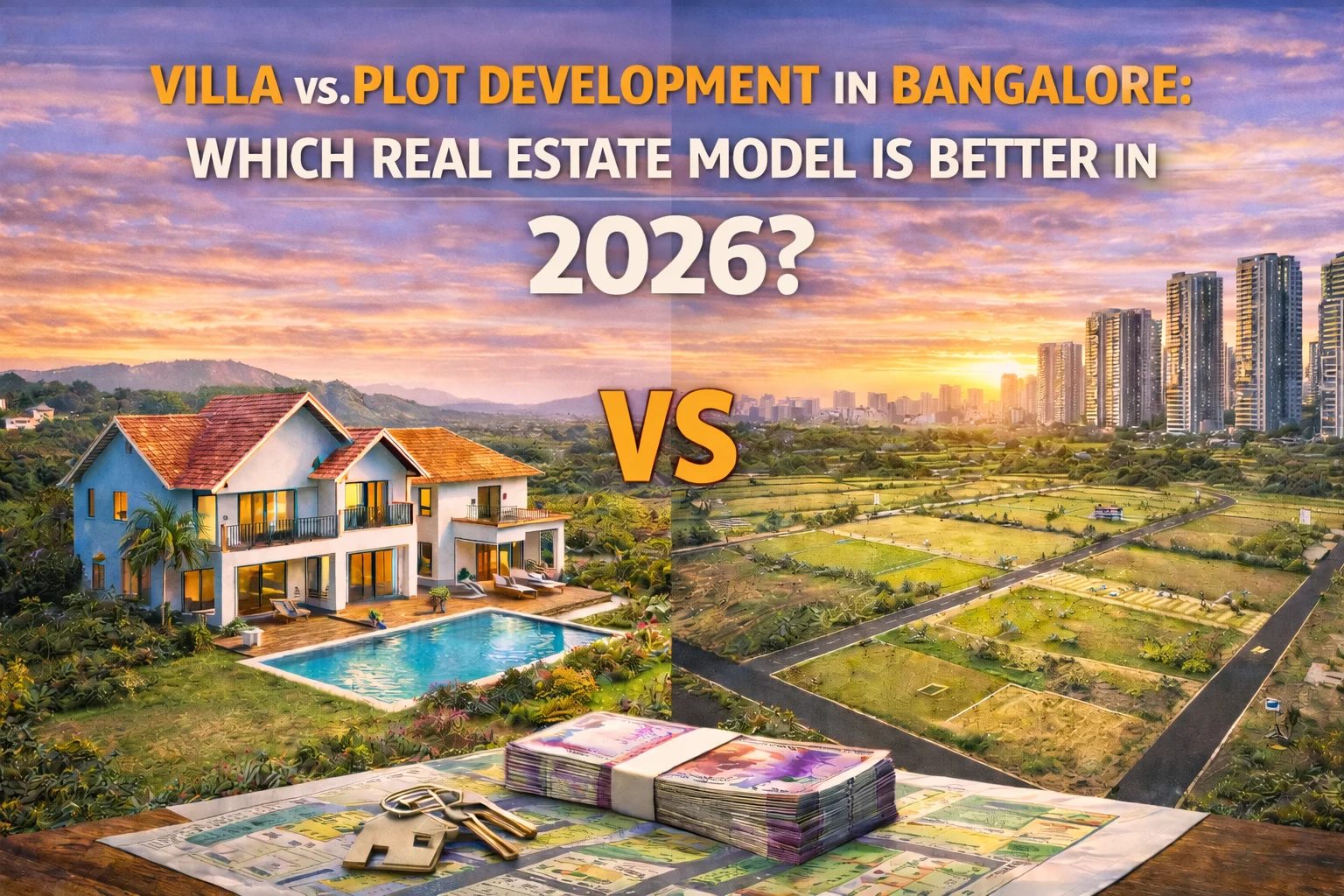
If you’ve been exploring Bangalore’s real estate market lately, you’ve probably noticed two dominant formats everywhere — gated villa communities and plotted developments.
And at first glance, they might look like two versions of the same thing.
But they’re not.
They’re actually two very different real estate development models, built around two very different investment philosophies.
One gives you a ready-built lifestyle product.
The other gives you land — and the freedom to decide what to build and when.
Now, I’ll be upfront. When I evaluate property in Bangalore, I rarely look at it from a short-term lens. I usually ask myself one question:
If I park my capital here for 7–10 years, where does the real appreciation come from?
And that question changes the entire comparison between villa projects and plotted developments.
So instead of just listing pros and cons, let’s break this down the way a serious investor would — especially in the context of Bangalore’s current growth corridors.
Understanding Real Estate Development Models in Bangalore
Before we compare returns, flexibility, or risk, we need to understand something important:
You’re not just choosing between a “villa” and a “plot.” You’re choosing between two different real estate development models in Bangalore.
And in a city expanding as aggressively as Bangalore with metro lines, peripheral ring roads, airport corridor growth, the development model matters more than most buyers realise.
Broadly, there are two dominant models:
- Villa Project Development Model
- Plotted Layout Development Model
Both are legal.
Both can be profitable.
Both have strong demand.
But they behave very differently over time.
And if you’re someone who believes that land value drives long-term wealth — like I do — then you’ll naturally start examining which model gives you higher exposure to appreciating land.
Let’s start with the villa model.
What Is a Villa Project Development Model in Bangalore?
In a villa project development model, the developer:
- Acquires a large land parcel
- Constructs independent villas
- Adds amenities (clubhouse, pool, security, landscaping)
- Sells fully built homes
When you buy into a villa project, you’re buying:
- The land
- The constructed building
- The shared infrastructure
- The lifestyle ecosystem
It’s convenient. It’s ready. It’s structured.
And for many buyers — especially end-users — that’s extremely attractive.
You don’t worry about construction approvals.
You don’t manage contractors.
You don’t phase construction over time.
You move in.
From a lifestyle standpoint, it’s hard to argue against that simplicity.
But here’s where I pause and think from a long-term capital perspective.
In a villa purchase, part of your investment goes into:
- The structure
- Interiors
- Finishes
- Fixtures
And unlike land, buildings depreciate over time. Maintenance increases. Renovation cycles kick in. Construction quality begins to matter more with age.
So while villa projects absolutely offer lifestyle comfort, from a purely long-term appreciation standpoint, you’re not fully exposed to land value alone.
And in markets like North Bangalore or emerging peripheral corridors — where land appreciation often drives the biggest upside — that distinction becomes important.
Now, let’s contrast this with plotted layout development in Bangalore — because this is where the long-term investment thesis starts to shift.
What Is Plotted Layout Development in Bangalore?
In a plotted layout development model, the developer:
- Acquires a large land parcel
- Gets the land converted (if required) for residential use
- Obtains layout approval from the relevant authority (for example, BMRDA or the local planning authority depending on the jurisdiction)
- Develops internal infrastructure — roads, drainage, electricity provisions, water lines, demarcation
- Sells individual plots to buyers
Unlike a villa project, the developer does not construct the house.
You purchase:
- A demarcated plot within an approved layout
- Access to internal infrastructure
- Sometimes amenities (clubhouse, parks, security)
- The freedom to build later, subject to local regulations
From a legal standpoint, properly approved plotted developments are usually:
- Bank loan eligible
- Layout-approved
- Clear in terms of road access and civic planning
And that approval component matters a lot in Bangalore, where raw land and unapproved sites still circulate in certain pockets.
Now here’s the structural difference that changes the investment conversation:
In a plotted development, your capital is almost entirely allocated toward land value.
There is no constructed structure depreciating over time. No initial cost loaded into walls, roofing, plumbing, finishes, or interiors.
That makes plotted layouts behave differently over long holding periods.
And if we’re talking about Bangalore’s expansion corridors — North Bangalore, Devanahalli belt, peripheral growth zones — appreciation is typically driven by:
- Infrastructure announcements
- Road connectivity
- Metro expansion
- Commercial development
- Land scarcity
Not by the age of a building.
That’s an important distinction.
Villa vs Plot Investment Bangalore: ROI Comparison
Capital Allocation
Villa Project
- You pay for land + construction + amenities.
- A significant portion of your purchase price goes into the built structure.
Plotted Development
- You pay primarily for land (plus proportionate infrastructure cost).
- Capital is concentrated in the appreciating asset class: land.
From a long-term appreciation standpoint, land historically behaves more predictably than built structures.
Buildings age. Land does not.
That doesn’t mean villas don’t appreciate — they do — but part of that appreciation must offset structural depreciation.
That’s why, if I’m thinking in terms of 7–10 year capital growth, I naturally pay attention to how much of my investment is exposed purely to land value.
Appreciation Behaviour in Bangalore
In emerging corridors of Bangalore:
- Early-stage growth is driven by infrastructure.
- Land values react first.
- Construction value does not scale at the same rate.
In established micro-markets (Whitefield, Sarjapur, parts of North Bangalore), villa demand may remain strong for end-use buyers.
But in developing corridors, plotted layouts often capture sharper upside because buyers are speculating on:
- Future connectivity
- IT and commercial expansion
- Peripheral ring road impact
- Airport corridor development
When appreciation is corridor-driven rather than lifestyle-driven, land-heavy assets tend to benefit more directly.
From a purely capital appreciation lens, that’s difficult to ignore.
Liquidity & Exit Flexibility
Liquidity differs between the two models.
Villa Projects
- Higher ticket size
- Narrower buyer pool
- Condition of structure affects resale value
- Maintenance history matters
Plotted Layouts
- Lower entry ticket (in many cases)
- Broader buyer pool
- Easier resale in growth corridors
- Buyers can build immediately or hold
In practical terms, resale of a plotted development often depends on:
- Location
- Layout approval
- Infrastructure completion
- Surrounding growth
Resale of a villa depends on all of that — plus:
- Age of construction
- Build quality
- Design relevance
- Maintenance condition
That additional variable layer adds complexity.
Risk Profile
No real estate model is risk-free.
Villa Project Risks
- Construction quality risk
- Developer execution risk
- Maintenance burden over time
- Higher upfront capital lock-in
Plotted Development Risks
- Approval risk (if improperly verified)
- Delayed infrastructure completion
- Slower absorption in early phases
The key is due diligence.
But structurally, plotted developments eliminate one risk component entirely:
Construction risk.
And for long-term investors who prefer simplicity in asset behaviour, that’s a meaningful difference.
Villa Construction vs Plot Development: Cost & Flexibility Analysis
Another overlooked factor is control.
When you buy a villa:
- Construction timeline is fixed.
- Design is predetermined.
- Cost is front-loaded.
When you buy a plotted development:
- You decide when to construct.
- You control construction budget.
- You can phase your capital deployment.
In rising construction cost environments — which Bangalore has seen repeatedly — flexibility becomes a strategic advantage.
Some investors prefer immediate asset utilisation.
Others prefer timing control.
Personally, when I evaluate long-term plays, I like the ability to separate land acquisition from construction timing. It gives capital planning flexibility without losing exposure to appreciation.
Plotted Layout Development vs Villa Project Bangalore: Legal & Approval Differences
When comparing villa projects and plotted layout developments, the legal framework isn’t entirely different — but the execution, approvals, and risk exposure vary.
And in Bangalore’s real estate market, approvals are not a small detail. They determine:
- Loan eligibility
- Resale ease
- Utility connections
- Long-term legal safety
Let’s break this down carefully.
Layout Approval & Planning Authority
In Bangalore and its surrounding planning zones, plotted developments typically require:
- Conversion of land to residential use (if originally agricultural)
- Approval from the relevant planning authority (for example, BMRDA or the local planning authority, depending on jurisdiction)
- Sanctioned layout plan
- Demarcated roads and civic infrastructure compliance
In a villa project, the developer must obtain:
- Land conversion (if applicable)
- Layout approval
- Building plan approval for each villa block
- Commencement certificate (where required)
- Completion certificate
- Occupancy certificate (for ready-to-move units)
So technically, villa projects require all approvals that plotted layouts require — plus construction-related approvals.
That adds another regulatory layer.
RERA Compliance
Under the Real Estate (Regulation and Development) Act (RERA):
- Both plotted developments and villa projects must register if they meet the size thresholds defined under the Act.
- Developers must disclose project details, timelines, approvals, and land status.
However:
In villa projects, RERA compliance also covers:
- Construction timelines
- Delivery obligations
- Structural specifications
In plotted developments, RERA primarily governs:
- Layout completion
- Infrastructure delivery
- Plot handover timelines
So from a buyer’s standpoint, villa projects carry additional construction delivery risk, whereas plotted layouts carry infrastructure completion risk.
Different exposure. Not necessarily higher — just different.
Building Plan Approvals
This is where the models structurally differ.
In a villa project:
- Building plans are pre-approved by the developer.
- The buyer doesn’t apply separately for construction permission (unless modifying the structure).
In a plotted development:
- The layout is approved.
- But the buyer must obtain individual building plan approval before constructing a house.
That means:
- More flexibility.
- More responsibility.
- Slightly more procedural work at the time of construction.
For long-term investors who don’t plan to build immediately, this isn’t a problem.
For immediate end-users, villa projects feel simpler.
Utility & Infrastructure Compliance
In approved plotted layouts:
- Roads, drainage, electricity provisions, and water lines must comply with sanctioned layout plans.
- Utility connections are typically applied for individually during construction.
In villa projects:
- Utilities are usually integrated and operational at handover.
- The developer manages initial compliance and internal distribution systems.
So from a regulatory execution standpoint, villas offer consolidated handling — plotted developments separate layout compliance from construction compliance.
Loan Eligibility & Bank Due Diligence
Banks typically assess:
- Land title clarity
- Layout approval status
- RERA registration (if applicable)
- Developer credibility
For villa projects:
- Banks also evaluate construction stage and structural valuation.
For plotted developments:
- Loan approval is primarily tied to land value and layout approval.
In both cases, properly approved projects from compliant developers are usually bankable.
The issue arises only when dealing with:
- Unapproved layouts
- Revenue sites
- Incomplete documentation
Which applies to either model if due diligence is weak.
Should You Choose Villa or Plot Development in 2026?
Segment:
- Investors
- End-use buyers
- NRIs
- Budget under 1 Cr
- 1–2 Cr buyers
- 2 Cr+ buyers
FAQ
Which Bangalore areas are better suited for villa projects versus plotted developments?
Established micro-markets with strong infrastructure and buyer density suit villa projects, while emerging growth corridors with larger land parcels favour plotted developments. Location maturity and target buyer profile largely determine the ideal format.
What approval risks should developers consider for villas vs plots in Bangalore?
Villa projects require building plan approvals, environmental compliance, and construction-related clearances, increasing regulatory complexity. Plotted developments mainly focus on land conversion, layout approval, and zoning compliance, but still require strict documentation.
Do Bangalore buyers prefer villas or plots in 2025?
Buyer preference depends on intent—end-users seeking ready living spaces lean toward villas, while investors and long-term planners prefer plots for appreciation potential. In emerging corridors, plotted demand often moves faster.
How do sales velocity and holding costs differ between villas and plotted projects?
Plotted projects usually achieve quicker sales velocity because of lower ticket sizes and phased development models. Villas carry higher holding costs due to construction timelines, inventory lock-in, and maintenance expenses.
When does a plot layout development make more sense than villas for developers?
Plot layouts work better when infrastructure is upcoming but not fully mature, allowing developers to enter early and exit faster. They are also ideal when buyer budgets are price-sensitive and demand is investment-driven.
How should developers decide between villa and plot projects based on land location?
If the land is in a premium, well-connected area with strong end-user demand, villas may yield better returns. However, in peripheral or high-growth corridors, plotted development often provides lower risk and higher scalability.
2 thoughts on “Villa vs. Plot Development in Bangalore: Which Real Estate Model Is Better in 2026?”