
Why the Hoskote–Malur Corridor Is Eastern Bengaluru’s Next Investment Trigger

The Hoskote–Malur Elevated Corridor is a key infrastructure project shaping eastern Bengaluru’s growth. Spanning 25.6 km, it forms part of a 110 km, six-lane highway connecting Devanahalli, Vemagal, Malur, and the Tamil Nadu border. As a result, the corridor improves industrial connectivity, logistics efficiency, and freight movement. Moreover, it integrates with the Bengaluru–Chennai Expressway, strengthening interstate trade.
The Hoskote–Malur Elevated Corridor Project marks a decisive step in Karnataka’s long-term infrastructure and industrial development strategy. Stretching 25.6 km between Hoskote and Malur, this elevated highway corridor is designed to unlock faster, cleaner, and more efficient connectivity across eastern Bengaluru’s emerging industrial belt.
Recently awarded to Bharat Vaniya Eastern Pvt Limited, this corridor forms a critical segment of the larger Devanahalli–Vemagal–Malur–Tamil Nadu border highway, a 110 km, six-lane infrastructure project aimed at strengthening interstate logistics and industrial mobility. As a result, the project is not merely a road upgrade—it is a foundational element of the Bengaluru Eastern Corridor Development vision.
More importantly, the corridor directly supports Karnataka’s ambition to build integrated industrial corridors, reduce freight congestion inside city limits, and improve regional competitiveness. Consequently, areas along Hoskote, Vemagal, and Malur are witnessing increased attention from logistics players, manufacturers, and infrastructure-led investors.
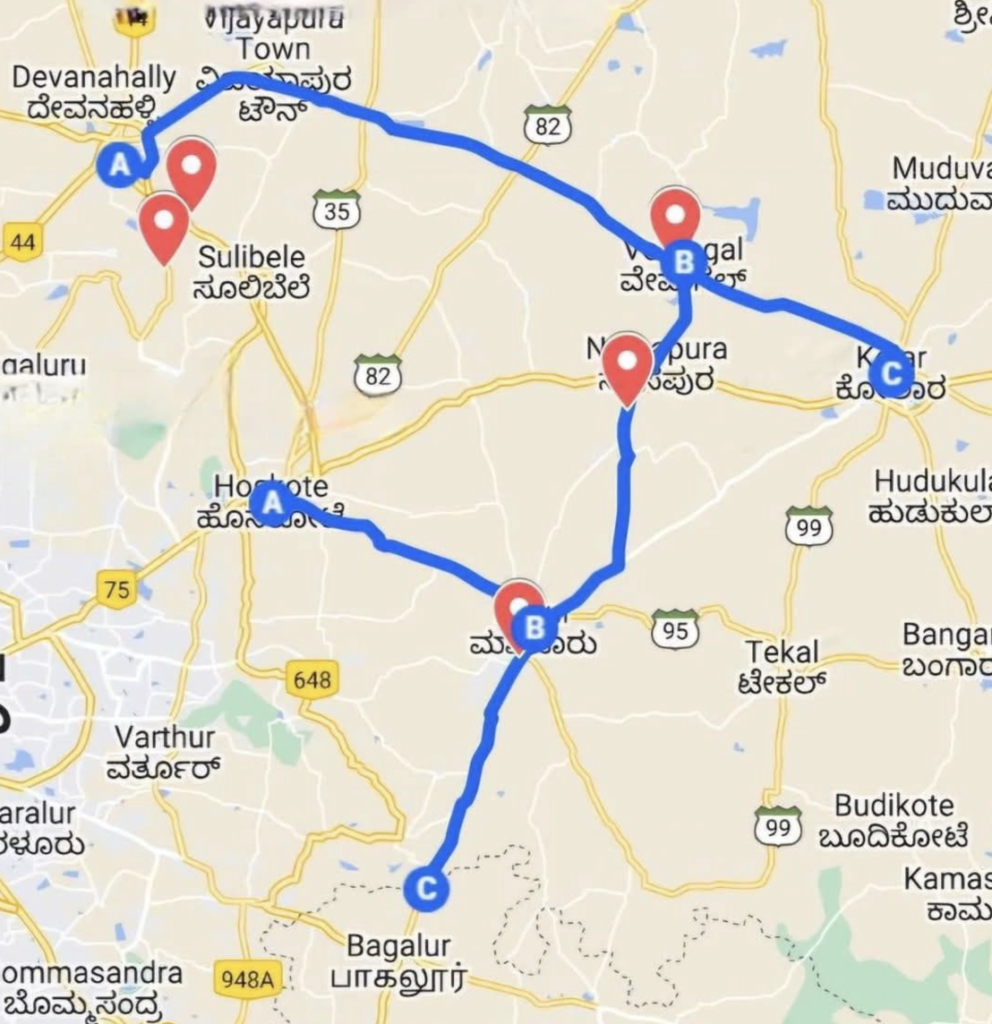
Project Overview
At its core, the Hoskote–Malur highway project focuses on constructing an elevated road corridor that enables uninterrupted, signal-free movement of commercial and passenger traffic. Unlike traditional surface highways, the elevated design minimises land acquisition challenges while ensuring smoother travel through industrial and semi-urban zones.
Furthermore, this corridor is executed under a package-based project model, allowing faster implementation and parallel development. The Hoskote–Malur stretch (Package 02) has already been awarded, while Package 01 (Vemagal to Tamil Nadu border) and Package 03 (Devanahalli to Vemagal/Kolar) are currently under evaluation. This phased execution ensures controlled timelines and better quality oversight.
In addition, the project integrates seamlessly into Karnataka’s broader infrastructure corridor framework, aligning with state highway upgrades, logistics parks, and industrial zones. Therefore, the elevated highway project in Bangalore is positioned as a backbone route for long-term economic expansion rather than a standalone transport solution.
Devanahalli–Vemagal–Malur–Tamil Nadu Border Highway Network
The Devanahalli–Vemagal–Malur highway represents a carefully planned multi-city, inter-district, and inter-state connectivity network. Starting from Devanahalli—close to the international airport—the route passes through Vemagal, Hoskote, and Malur, eventually linking to the Tamil Nadu border.
As a result, the corridor connects aviation hubs, industrial clusters, logistics parks, and manufacturing zones into one continuous mobility spine. Moreover, it strengthens eastward connectivity from Bengaluru without forcing heavy vehicles to pass through congested urban roads.
From a logistics perspective, this Bengaluru logistics corridor dramatically improves last-mile and mid-mile freight efficiency. Consequently, industrial operators in eastern Karnataka gain faster access to ports, warehouses, and interstate trade routes. This is precisely why the project is viewed as a catalyst for the Industrial Corridor Karnataka ecosystem.
Integration with Bengaluru–Chennai Expressway
Perhaps the most strategic advantage of the Hoskote–Malur Elevated Corridor Project lies in its integration with the Bengaluru–Chennai Expressway connectivity. This linkage effectively connects Karnataka’s manufacturing and logistics zones to one of India’s most important national trade corridors.
Because of this integration, freight movement between Bengaluru and Chennai becomes significantly faster, more predictable, and cost-efficient. Additionally, the corridor supports national logistics corridor alignment, reducing dependency on overburdened city highways.
Meanwhile, industrial units benefit from reduced turnaround times, improved supply chain reliability, and better access to export infrastructure. Therefore, the corridor acts as a trade and transport multiplier, directly supporting the Bengaluru industrial corridor project objectives.
In the long run, this expressway-linked elevated corridor will play a defining role in shaping Eastern Bengaluru growth corridors, positioning them as preferred destinations for industrial, warehousing, and infrastructure-led development.
Industrial Corridor Development Impact on Hoskote–Malur Corridor Project
The Hoskote–Malur Elevated Corridor Project plays a pivotal role in strengthening Eastern Bengaluru’s industrial corridor development. By improving high-capacity road connectivity, the project directly supports manufacturing clusters located across Hoskote, Vemagal, Malur, and nearby industrial belts. As a result, factories gain faster access to raw materials, suppliers, and outbound markets.
Moreover, the corridor enables the expansion of logistics and warehousing hubs, which are critical to modern supply chains. With improved highway-grade connectivity, logistics operators can establish large-format warehouses closer to production zones, thereby reducing transit delays and operational costs. Consequently, industrial parks and SEZs along this corridor become more competitive and scalable.
At the same time, the improved infrastructure supports MSME ecosystem development. Smaller manufacturers and ancillary units benefit from better transport reliability, allowing them to integrate into regional and interstate supply chains more efficiently. Over time, this leads to a broader supply chain transformation, where Eastern Bengaluru evolves from a fragmented industrial zone into a coordinated logistics-driven manufacturing corridor.
Economic Growth and Employment Generation
Infrastructure-led corridors often act as economic accelerators, and the Hoskote–Malur corridor is no exception. During construction, the project generates direct employment across engineering, construction, material supply, and project management sectors. Simultaneously, indirect jobs emerge in transport services, equipment rentals, and local businesses.
Beyond construction, the long-term impact is even more significant. Improved connectivity attracts industrial investment, which fuels regional economic upliftment. As new businesses establish operations along the corridor, the broader business ecosystem expands to include services, maintenance, logistics, and support functions.
Furthermore, SMEs and service-sector enterprises—such as transport operators, food services, and facility management providers—experience steady demand growth. Over time, this creates long-term economic multiplier effects, where infrastructure investment leads to sustained income generation and economic resilience across the region.
Urban Development and Regional Transformation
The corridor also influences urban development patterns across eastern Karnataka. As accessibility improves, new urban clusters and satellite towns begin to form around industrial and logistics hubs. This infrastructure-driven urbanization helps distribute population growth more evenly, reducing pressure on Bengaluru’s core areas.
Additionally, improved road infrastructure encourages planned social infrastructure development, including schools, healthcare facilities, and community amenities. When aligned with smart city planning frameworks, such corridors support data-driven traffic management, utility planning, and sustainable growth models.
Most importantly, the project contributes to balanced regional development, ensuring that economic growth spreads beyond established urban centers into emerging zones.
Transportation Efficiency and Mobility Benefits
From a mobility standpoint, the elevated corridor significantly improves transportation efficiency. By diverting heavy vehicles away from congested city roads, it supports meaningful traffic decongestion. As a result, travel times between industrial hubs reduce substantially.
Additionally, the corridor provides safer logistics and freight routes, minimising conflict between local traffic and commercial vehicles. For daily commuters, improved connectivity translates into smoother inter-town travel and better access to employment zones. Collectively, these factors enhance overall transport network optimisation across Eastern Bengaluru.
Real Estate and Land Value Implications
Historically, major infrastructure corridors drive infrastructure-led property appreciation, and this corridor follows the same pattern. Improved access stimulates residential corridor growth, while rising industrial activity increases demand for commercial and industrial real estate.
Over time, the region begins to function as an investment corridor, supported by long-term land-use transformation rather than speculative growth.
Environmental and Sustainable Planning Considerations
Finally, the elevated design offers environmental advantages. It enables controlled urban sprawl, preserves ground-level land use, and supports sustainable planning practices. When combined with green buffers and impact management strategies, the project aligns with responsible infrastructure development goals.
Tender Status and Project Execution
The Hoskote–Malur Elevated Corridor Project follows a structured, transparent execution framework designed to ensure timely delivery and quality control. Currently, the 25.6 km Hoskote–Malur package (Package 02) has been awarded to Bharat Vaniya Eastern Pvt Limited, marking a significant milestone in the overall corridor development.
Meanwhile, the remaining tender packages—including Vemagal to Tamil Nadu border (Package 01) and Devanahalli to Vemagal/Kolar (Package 03)—are under evaluation. This staggered tendering approach allows authorities to assess technical and financial viability while minimising execution risks. As a result, project continuity remains intact even as different segments progress at varied timelines.
Furthermore, the corridor adopts a phased execution strategy, enabling parallel construction across multiple stretches. This approach accelerates delivery while maintaining operational flexibility. Development sequencing is carefully planned to prioritize high-impact segments that improve industrial connectivity early in the project lifecycle.
From a governance perspective, the project operates under a clearly defined implementation framework, supported by state-level oversight and established highway development norms. Consequently, accountability, compliance, and quality benchmarks remain central throughout execution.
Long-Term Vision for Karnataka’s Eastern Growth Corridor
Beyond immediate connectivity gains, the corridor forms a cornerstone of Karnataka’s eastern growth strategy. By linking Devanahalli, Hoskote, Vemagal, Malur, and the Tamil Nadu border, the project strengthens integrated infrastructure planning across districts and economic zones.
Importantly, the corridor aligns with industrial policy objectives, encouraging manufacturing, logistics, and export-oriented industries to decentralise from saturated urban centres. Over time, this enables multi-city economic clustering, where industrial hubs, logistics parks, and residential zones evolve in a coordinated manner.
Additionally, the corridor enhances global investment positioning by improving access to national expressways, ports, and interstate trade routes. For international investors and large-scale manufacturers, such infrastructure reliability is a critical decision factor. Therefore, Eastern Bengaluru emerges as a competitive alternative to established industrial belts.
Conclusion on Hoskote–Malur Corridor Project
The Hoskote–Malur Elevated Corridor Project demonstrates how infrastructure acts as a powerful development catalyst rather than a standalone asset. By combining strategic connectivity, phased execution, and policy alignment, the corridor addresses long-term economic and mobility challenges.
More importantly, its strategic importance extends beyond road development. It enables industrial expansion, supports urban transformation, and strengthens regional competitiveness. Over time, the corridor will play a defining role in the economic and spatial transformation of eastern Karnataka.
Ultimately, this project positions Eastern Bengaluru and surrounding districts as a future-ready growth powerhouse, driven by infrastructure, industry, and integrated regional planning.
Who has been awarded the Hoskote–Malur elevated corridor package?
The Hoskote–Malur package has been awarded to Bharat Vaniya Eastern Pvt Limited. This marks the start of execution for one of the key segments of the corridor. Meanwhile, other packages are being processed separately.
Which regions are connected by the 110 km highway development project?
The highway connects Devanahalli, Vemagal, Hoskote, Malur, and the Tamil Nadu border. Together, these regions form an important industrial and logistics belt. Therefore, the project strengthens both inter-district and inter-state connectivity.
How does the Hoskote–Malur corridor integrate with the Bengaluru–Chennai Expressway?
The corridor links directly with the Bengaluru–Chennai Expressway network. Because of this, freight and passenger movement between Karnataka and Tamil Nadu becomes faster and more efficient. As a result, logistics costs and travel time are reduced significantly.
What impact will this corridor have on industrial development in Karnataka?
The corridor improves access to manufacturing zones, logistics hubs, and industrial parks. Consequently, industries can move goods more smoothly and expand operations. Over time, this supports stronger industrial growth across eastern Karnataka.
How will the project benefit the eastern Bengaluru region?
Eastern Bengaluru will see better connectivity, reduced traffic congestion, and improved access to employment hubs. Moreover, the corridor encourages planned urban and industrial development. Therefore, the region becomes more attractive for long-term growth.
What is the current status of the remaining tender packages?
While the Hoskote–Malur package has been awarded, other segments are still under evaluation. These packages are being processed in phases to ensure quality and timely execution. Meanwhile, planning and approvals continue in parallel.
Why is the Hoskote–Malur corridor strategically important for Karnataka’s infrastructure growth?
The corridor connects airports, industrial zones, and interstate highways into one network. Because of this integration, it supports economic growth beyond city limits. Ultimately, it strengthens Karnataka’s position as a major industrial and logistics hub.
With the Hoskote–Malur Elevated Corridor, Bengaluru’s industrial belt is about to get a huge boost. Integrating it with the Bengaluru–Chennai Expressway shows how strategic planning can improve freight flow and cut down on congestion.
Very informative piece on the Hoskote–Malur Corridor — it clearly shows how this new elevated highway will boost freight movement and ease logistics flow between Bengaluru’s industrial belt and interstate trade routes. I liked how it highlights the project’s integration with the Bengaluru–Chennai Expressway and the way it supports industrial growth and better access for warehouses and manufacturers. A great snapshot of how strategic infrastructure can transform regional connectivity!